China contributes nearly two-thirds of Matter-certified products worldwide. Behind this scale is a broader shift: China’s smart device supply chain is evolving from manufacturing strength toward ecosystem integration, device identity, trusted production, and lifecycle security.
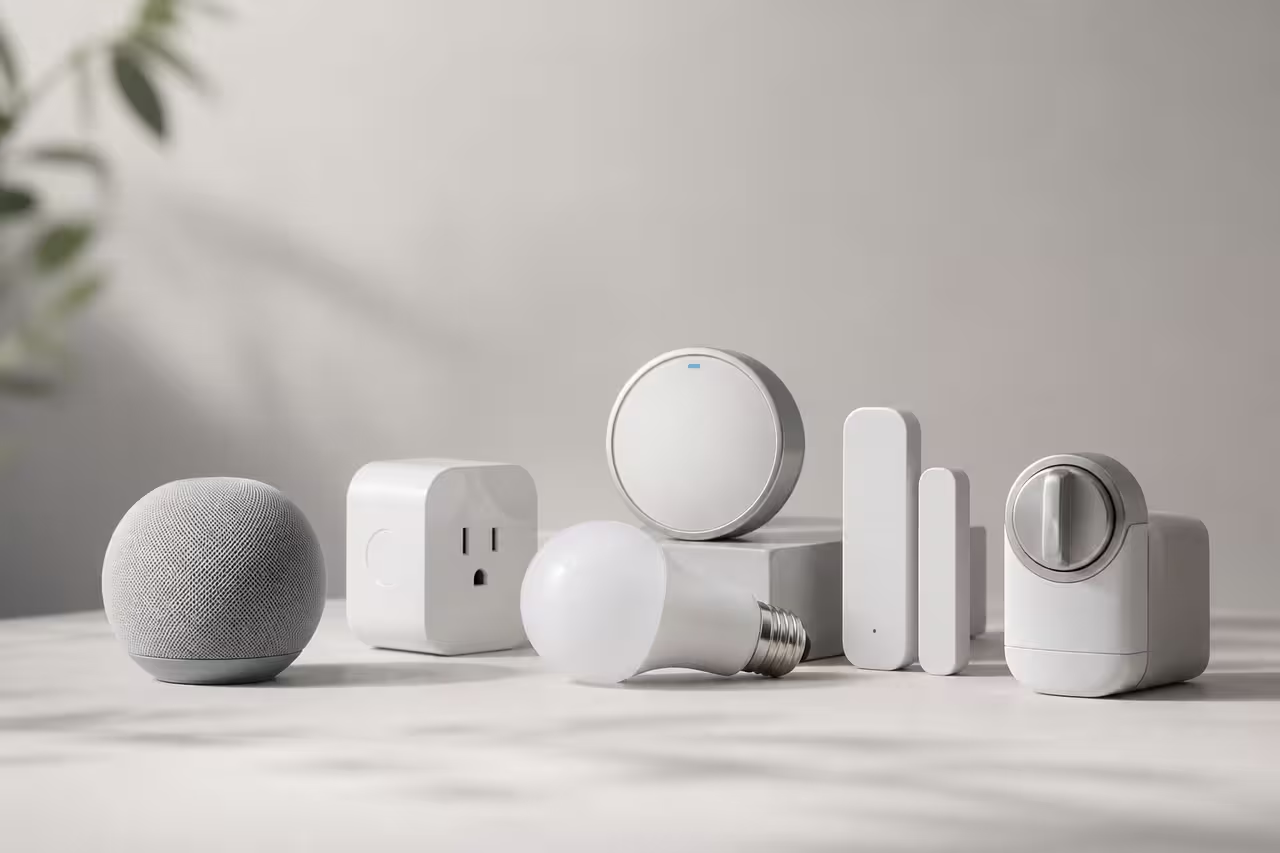
According to data presented at the 2025 Matter China Developer Conference, more than 5,900 Matter-certified products and related components had been certified worldwide by the time of the event. More than 2,670 products had also been uploaded to the Distributed Compliance Ledger (DCL), completing an important step toward market readiness.
China accounted for nearly two-thirds of Matter-certified products worldwide, making it a major contributor to the continued expansion of the Matter ecosystem. Chinese companies also ranked prominently among those with the highest numbers of Matter certifications over the previous twelve months.
For anyone familiar with the smart device industry, this trend is not particularly surprising. The global smart home market has long relied on China’s mature electronics manufacturing ecosystem. From solution design and module supply to mass production, manufacturing clusters in the Pearl River Delta, Yangtze River Delta, and other regions have developed highly integrated supply chain capabilities.
But attributing these results solely to manufacturing capacity would miss a more important shift. China’s supply chain is evolving from a manufacturing participant into an ecosystem capability provider. If the previous generation of smart hardware competition was largely about manufacturing capability, Matter is increasingly shifting competition toward a combination of standards, security, and digital capabilities.
With Matter, competition is no longer limited to producing hardware. It increasingly involves device identity, certification trust chains, ecosystem onboarding, and lifecycle security management.
China’s contribution of nearly two-thirds of Matter-certified products is undoubtedly supported by its manufacturing strength. But scale alone no longer explains the full picture. Chinese companies are expanding beyond device manufacturing into areas such as chips, development tools, certification support, and platform services.
Matter is not simply another connectivity protocol. Through standardized device definitions, certification mechanisms, and ecosystem onboarding rules, Matter reduces interoperability barriers between different smart home ecosystems. At the same time, it shifts competition from "Who can manufacture devices faster?" toward "Who can help customers enter the global smart home ecosystem more efficiently?" For OEMs, this means dealing with multiple requirements at the same time, including chip adaptation, SDK development, protocol stack integration, product certification, and lifecycle management. Standardization does not automatically eliminate these implementation challenges.
This is why an increasing number of Chinese chip and module companies are expanding their capabilities across the value chain. In addition to hardware, they are providing development tools, certification support, ecosystem integration, and cloud services to help customers shorten product development and certification cycles and reduce the cost of entering global markets. Traditional manufacturing advantages are therefore evolving into broader capabilities in platforms, ecosystem integration, and long-term services.
China’s leading share of Matter-certified products is not simply the result of “manufacturing more.” It reflects a broader shift in industry roles—from delivering devices to helping customers enter and continuously operate within the global smart home ecosystem.
One of the important differences between Matter and many traditional consumer IoT solutions is its PKI-based Device Attestation mechanism. Every Matter device needs a digital identity that complies with the Matter PKI framework and uses a Device Attestation Certificate (DAC) to prove the authenticity and origin of the device.
Historically, much of the trust infrastructure supporting Matter PKI was provided by qualified international organizations, with relatively limited participation from Chinese companies. As the Matter ecosystem develops, some Chinese companies are beginning to participate in this infrastructure as well.
This indicates that China’s supply chain is expanding into more critical parts of the Matter ecosystem—from chips, modules, and product manufacturing toward the certification and device trust chain itself.
.avif)
Strong manufacturing capabilities do not mean that every challenge has been solved. China’s manufacturing ecosystem is already highly capable of rapid prototyping, mass production, and global delivery. Entering the global Matter ecosystem, however, requires another layer of digital capabilities.
From development to mass production, a Matter product may require manufacturers to manage:
These processes are not simply software configuration tasks. They can directly affect certification validity, production efficiency, and downstream device management.
In some organizations, certificate transfer, device identity information, and production records still rely on manual processes or disconnected tools. This creates a new type of efficiency bottleneck: Hardware development and manufacturing cycles are getting shorter, while device identity, certificate, and certification data management can still slow down product delivery.
A device may be manufactured quickly, but if its certificate chain is incorrectly configured, device identity information is missing, or certification records cannot be traced, the product may still face delays in certification and global market entry.
.avif)
During the early development of the Matter ecosystem, one of the main priorities for companies was achieving product certification. China’s supply chain has already demonstrated its ability to manufacture and certify products at scale. The next stage of competition will increasingly depend on which companies can translate global technical standards and security requirements into production capabilities that are secure, efficient, and repeatable at scale.
For smart device manufacturers, this means reconsidering how security assets, device identities, and lifecycle information are managed across production. Keys and certificates need to be used within appropriate security boundaries. Devices need unique and trustworthy identities. Manufacturing processes need complete and traceable records.
At the same time, manufacturers increasingly need to address lifecycle security requirements such as SBOM management, vulnerability response, and OTA updates. As hardware capabilities become increasingly standardized, device identity, security asset management, and lifecycle security capabilities will become more important sources of competitive differentiation.
New-generation device security governance platforms such as OnBoard™ IoT Security (OBIS) help OEMs manage device identities, security assets, production records, and device status within a unified framework. This supports secure, trusted, and traceable delivery at scale while improving collaboration across the supply chain.
The continued growth of Matter-certified products shows that China’s smart hardware supply chain is evolving beyond manufacturing scale toward broader ecosystem capabilities. As this transition continues, Chinese companies are playing an increasingly important role in the Matter ecosystem. But the next stage of competition will not be determined by production speed alone.
It will increasingly depend on the ability to connect manufacturing capabilities with global standards, trusted device identity, security requirements, and lifecycle management.