The first two European standards supporting the CRA, EN 40000-1-1 and EN 40000-1-2, have been published. They cover cybersecurity terminology, product risk management, and lifecycle activities. This article explains what the standards address, what they mean for device manufacturers, and how companies can prepare.
On November 19, 2026, CEN and CENELEC announced the publication of the first two European standards supporting the implementation of the EU Cyber Resilience Act (CRA). The official texts became available on November 18:
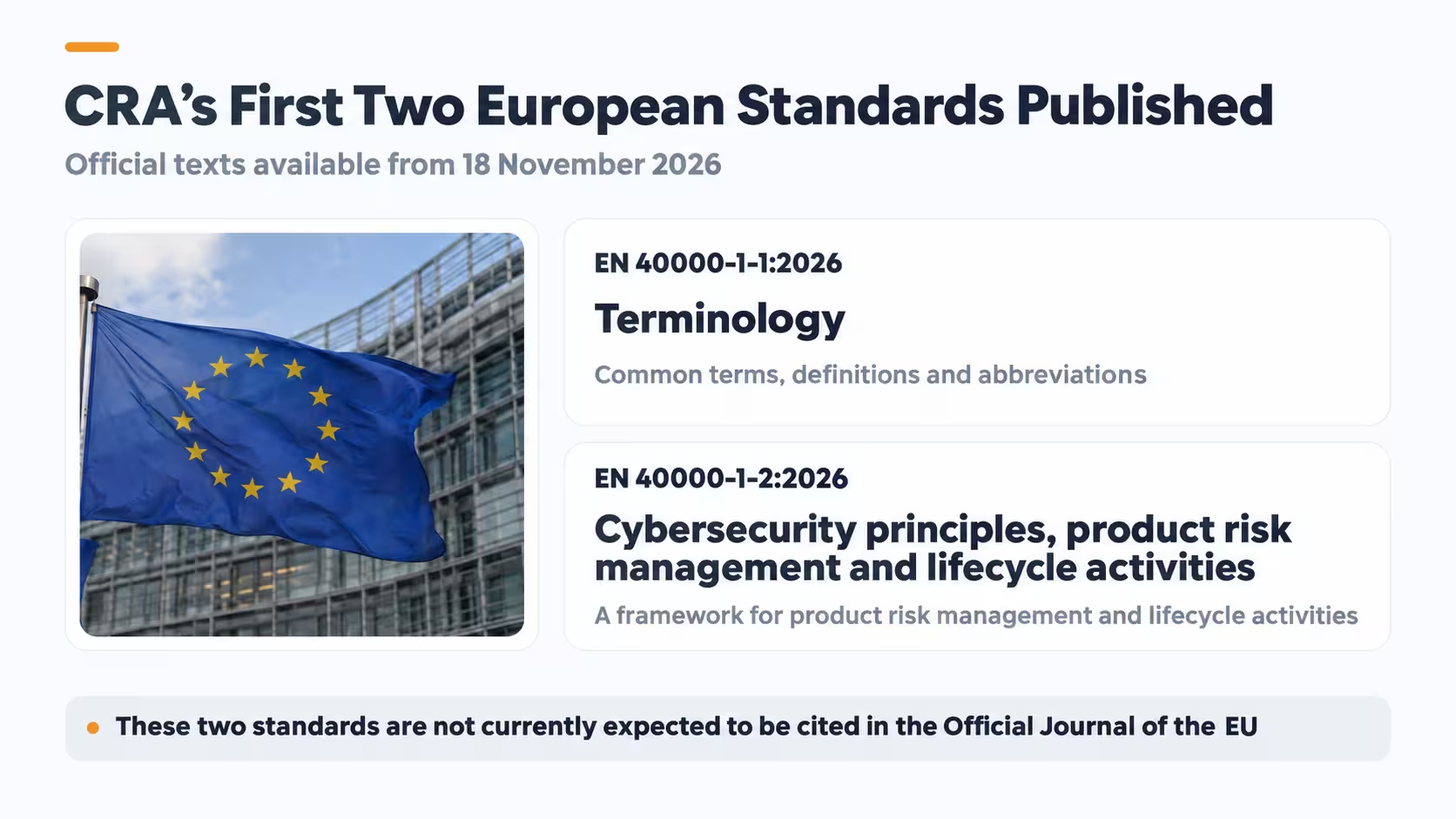
Both standards were developed under the European Commission's standardisation request M/606, which covers 41 standards supporting the CRA. These are divided into horizontal standards, applicable across product categories, and vertical standards, addressing specific product categories. The two newly published standards form part of the foundational horizontal standards. Work on vulnerability handling, general technical requirements, and product-specific standards is still ongoing.
A European Commission news release published around the same time noted that connected door locks, routers, microprocessors, microcontrollers (MCUs), and qualifying supporting cloud services are within the CRA's scope. Device manufacturers, chip and component suppliers, and companies providing related cloud functionality should therefore pay attention to these developments.
EN 40000-1-1 helps teams and companies across the supply chain communicate using consistent terminology. EN 40000-1-2 helps companies organise product risk management and lifecycle security activities.
For products that already support secure boot, encrypted communications, and remote updates, these standards highlight the need to look beyond the presence of security features. Companies should also confirm which risks those features address, whether the protections remain effective during production and after delivery, and who is responsible when problems arise.
The following sections explain the role of both standards using publicly available official information and practical product scenarios. The examples and recommendations are intended to aid understanding; the formal standards remain the authoritative source for specific requirements. Before examining these questions, companies first need to make sure everyone is talking about the same product.
During the development of a connected device, engineering teams, suppliers, and cloud teams may each provide their own documentation. But when discussing what constitutes the product, their understanding may differ. The hardware team focuses on the device leaving the factory. The app team focuses on account login and device commissioning. The cloud team treats the backend as a separate service.
When teams define the product differently, risk analysis may overlook interfaces and dependencies between the device, app, and cloud services. Responsibilities can also fall through the gaps. Product scope must first be determined under the CRA. For example, whether a supporting cloud function forms part of the product depends on the CRA's definition of a remote data processing solution.
EN 40000-1-1 provides common terminology for the entire standards series. Companies can use it to review internal specifications, supplier agreements, and security documentation. Chip and component suppliers also need to clearly define what their deliverables include. Common terminology does not replace agreements on responsibilities, but it helps make those agreements clearer.
Once the product scope is understood, the next questions are what risks the product faces and whether existing measures are sufficient.
Listing security features is not enough. Companies also need to explain which risks each feature is intended to address.
Consider a product with secure boot, encrypted communications, and remote firmware updates. For the update process:
These are examples, not implementation methods prescribed by the standards. They illustrate why security features need to be linked to risk analysis so that potential gaps in protection can be identified.
This is also reflected in Article 13 of the CRA. Manufacturers must assess the cybersecurity risks associated with their products, take the results into account during planning, design, development, production, delivery, and maintenance, and include the risk assessment in the technical documentation.
EN 40000-1-2 brings cybersecurity principles, product risk management, and lifecycle activities into a common framework. Companies can use it to review four questions: What risks have been identified? Why were particular measures selected? How is their effectiveness verified? What records support these conclusions?
Risk management also needs to continue after delivery. Third-party components may develop new vulnerabilities, firmware may gain new features, and cloud services may change.
When a product enters mass production, the security requirements established during design must be carried out on the factory floor. Manufacturers need to verify that the correct firmware version has been programmed, security settings have taken effect, and device identity information has been provisioned successfully. The results also need to be recorded.
After shipment, the questions change. If a vulnerability is discovered in a component, who determines whether the product is affected? Who validates the patch? How will the update be delivered, and how will users be informed?
The value of a lifecycle framework is that it connects work across these stages and helps prevent gaps in responsibility during handovers.
Some of these activities are already subject to regulatory deadlines. The reporting obligations under Article 14 of the CRA have applied since September 11, 2026. They cover actively exploited vulnerabilities and severe incidents affecting product security.
Once a manufacturer becomes aware of a reportable issue, it must submit an early warning without undue delay and within 24 hours at the latest, followed by a notification within 72 hours. A final report must then be submitted within the applicable deadline.
If the team is still trying to identify the responsible person, check affected firmware versions, or request information from suppliers, the time available for assessment and reporting will quickly shrink.
Reporting processes therefore need to be operational now.
Choose a representative product and work through four steps:
Companies that already have secure development processes, test reports, or analyses based on draft standards can first identify which materials remain usable. They can then conduct a gap analysis as additional standards become available.
Under Article 27 of the CRA, compliance with harmonised standards, or the relevant parts of those standards, that have been referenced in the Official Journal of the European Union (OJEU) can provide a presumption of conformity for the essential requirements they cover.
This does not mean that a product automatically meets every CRA obligation.
As of November 20, 2026, the CEN-CENELEC project records for both standards indicate that they are not expected to be cited in the OJEU under the CRA. They should therefore not be treated as standards that provide a presumption of conformity.
Companies should continue monitoring the development of standards covering vulnerability handling, general technical requirements, and specific product categories.
Smart door locks, certain routers, and some MCUs with security-related functions fall, or may fall, within CRA Class I important product categories.
Chip classification depends on the product's specific functionality. For example, tamper-resistant microcontrollers are listed as Class II important products.
For Class I products, manufacturers may use the internal control procedure when they fully apply the relevant harmonised standards, common specifications, or qualifying certification schemes covering the applicable essential requirements. Otherwise, a conformity assessment procedure involving a third party must be selected in accordance with Article 32.
Activities involving design changes, supplier coordination, or third-party assessment should be planned early.
Secure boot, encrypted communications, and remote updates are important foundations of product security. But companies also need to explain which risks these measures address, how they are verified, and who will maintain them after delivery.
With approximately one year remaining before the CRA's main requirements apply on December 11, 2027, reviewing existing products and processes early gives manufacturers more time to address design changes, coordinate with suppliers, and complete additional verification.
Demonstrating that security work has been carried out requires supporting analysis, verification results, and operational records.
For example, when a vulnerability is discovered in a particular firmware version, a company first needs to identify which devices are running that version.
The OnBoard™ IoT Security (OBIS) platform can link device identities, firmware versions, security configurations, and production batches. This helps manufacturers quickly identify potentially affected devices and provides a basis for further impact analysis and remediation.