CRA compliance is not simply a checklist of requirements. It is built on four cybersecurity principles that guide how IoT products are designed, delivered, and managed throughout their lifecycle.
The EU Cyber Resilience Act (CRA) officially entered into force in December 2024. For manufacturers of Products with Digital Elements (PDEs) seeking continued access to the EU market, the next major compliance milestone will be 11 September 2026. From that date, reporting obligations for actively exploited vulnerabilities and serious security incidents will become applicable. Companies will need to establish lifecycle cybersecurity management capabilities covering vulnerability discovery, risk assessment, incident reporting, vulnerability remediation, and security updates. When preparing for CRA compliance, many manufacturers start with practical questions:
However, if the CRA is reduced to a simple checklist, organizations can easily fall into a “check-the-box” compliance mindset. The reason is that the CRA is not limited to the pre-market phase; it applies throughout the entire product lifecycle, including product design, software development, manufacturing, deployment, vulnerability management, security updates, and lifecycle maintenance.
It also requires collaboration across different stakeholders, including:
Effective CRA compliance is therefore not about completing isolated tasks. It requires building a continuous product security capability. From an enterprise implementation perspective, CRA requirements can be distilled into four key security principles:
.avif)
These principles answer four fundamental questions:
Understanding these principles provides manufacturers with a clearer path toward sustainable CRA compliance.
Cybersecurity is not about applying the highest level of protection everywhere. A risk-based approach requires manufacturers to understand:
Simply put, risk is not the same as whether a vulnerability exists; it depends on the likelihood that a vulnerability can be exploited and the potential impact.
For example, a security issue affecting local access to a single smart lock and a vulnerability that could enable remote control of a large number of devices are both security concerns. However, they require different mitigation approaches due to differences in likelihood and potential impact.
.avif)
A risk-based approach helps manufacturers determine:
Risk-based security provides the foundation for the entire product security strategy.
The core idea of Security by Design is simple: Security should be considered from the beginning of product development, not added later as a patch after problems appear.
Security should be integrated into product architecture, software development, manufacturing processes, and lifecycle planning.
For IoT products, Security by Design is not about simply adding individual security features; it is about systematically integrating security principles into product architecture, development processes, and operational mechanisms.
Devices, services, and users should only have the minimum permissions required to perform their intended functions. Simply put: A component should not have more authority than it actually needs.
For example, a smart camera can upload video to the cloud, but it should not have default access privileges to other devices on the home network.
By limiting permissions, manufacturers can reduce the potential impact if a component is compromised.
Manufacturers should reduce the attack surface that can be exploited by attackers. Simply put: The fewer unnecessary interfaces a product exposes, the fewer opportunities attackers have.
For example, an IoT gateway may contain potential attack entry points, such as network interfaces, debugging interfaces, web management services, and USB ports.
Capabilities that are not required for normal operation should be:
Reducing the attack surface helps lower the likelihood of successful attacks.
Security should not rely on a single protection mechanism. Simply put: A secure product should not depend on one security layer.
For example, a smart door lock can incorporate multiple security mechanisms, including identity authentication, encrypted communication, Secure Boot, and firmware integrity verification.
Even if one security layer is compromised, additional protections can continue reducing risk.
.avif)
Security needs to be integrated into the software development process. Many vulnerabilities originate from software defects, insecure coding practices, or unmanaged third-party components. Examples include:
This is also why Software Bill of Materials (SBOM) and vulnerability management have become important parts of lifecycle cybersecurity.
Security should not depend on keeping design details or implementation information secret. Simply put: A system should not be considered secure only because attackers do not know how it works.
For example, a manufacturer should not assume that “attackers do not know our communication protocol, so the device is secure.”
Real security should rely on:
Even if the system design becomes known, the product should remain secure.
Security design should consider how users actually interact with products. Simply put: Products should not assume that users will always operate them as expected.
For example, if a device requires users to complete complex security configurations, they may adopt insecure practices, such as using weak passwords, disabling security features, or ignoring security updates. Therefore, product design should reduce the security burden on users by providing secure default settings, simplifying security-related workflows, and implementing safeguards against user misconfigurations.
Security by design should not focus solely on the pre-market phase of a product. Instead, it should cover the entire product lifecycle, including development, production, deployment, operation, updates, and decommissioning.
For example, after a device is deployed, it still requires continuous activities such as vulnerability management, SBOM maintenance, security update releases, device identity management, and secure decommissioning.
Simply put: Product security does not end when a device leaves the factory. It continues throughout the product lifecycle.
If Security by Design focuses on how products are built. Security by Default focuses on what security state products have when they reach users.
Security by Default requires products to provide reasonable security protection without requiring users to complete complex security configuration.
For example, products should not:
Instead, products should:
Security by Design builds security capabilities into the product. Security by Default ensures that these security capabilities are effective when the product is delivered.
The first three principles focus on making products secure. Transparency addresses how stakeholders can understand and maintain the security status of a product. Transparency does not mean publishing every technical detail. It means providing the right information to the right stakeholders.
For example, different stakeholders require different types of security information:
Transparency allows different stakeholders across the ecosystem to collaborate based on shared security information.
The four principles are not independent activities. Together, they form a complete security lifecycle.
In simple terms: risk-based approaches set the direction; security by design enables implementation; secure by default ensures secure delivery; and transparency supports communication and assurance.
CRA compliance is therefore not four separate activities. It is a connected cybersecurity system.
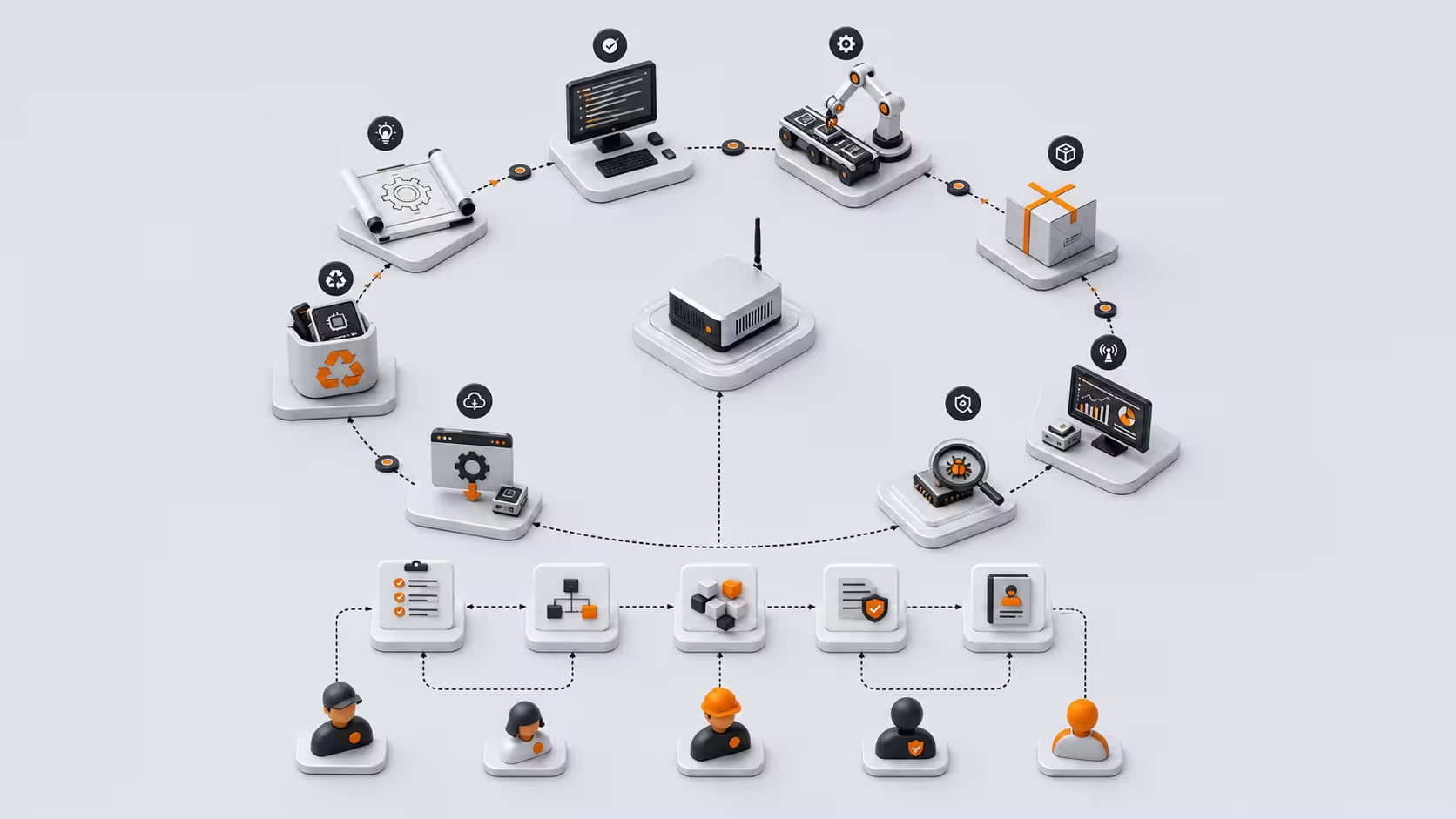
Principles need to become practical activities and measurable evidence.
Simply put: Principles explain why. Activities explain how. Evidence proves it was done.
The CRA may appear complex, but its underlying logic is straightforward. A strong CRA compliance approach requires manufacturers to:
Together, these four principles create the foundation for lifecycle cybersecurity. For IoT manufacturers, CRA is not merely a one-time compliance task; it drives organizations to establish security management capabilities throughout the entire product lifecycle.