Matter 1.6.1 focuses on refining existing capabilities, including Groupcast, Intermittently Connected Devices (ICD), access control, and group key management. This article explores the key updates and what module vendors and OEMs should consider for SDK upgrades, certification, production testing, and long-term device maintenance.
Matter 1.6.1 has been officially released. While Matter 1.6 expanded capabilities such as NFC-based commissioning, multi-ecosystem coordination, and device capability representation, this update focuses mainly on refining existing features. It introduces no new device types and instead addresses issues in protocol implementation and real-world operation.
These changes may not be immediately visible to consumers, but they affect development, certification, and mass production for module vendors and OEMs. For Matter products already in production or deployment, manufacturers need to look beyond feature support and consider stability in complex environments, SDK upgrades, and the ongoing maintenance of devices already in the field.
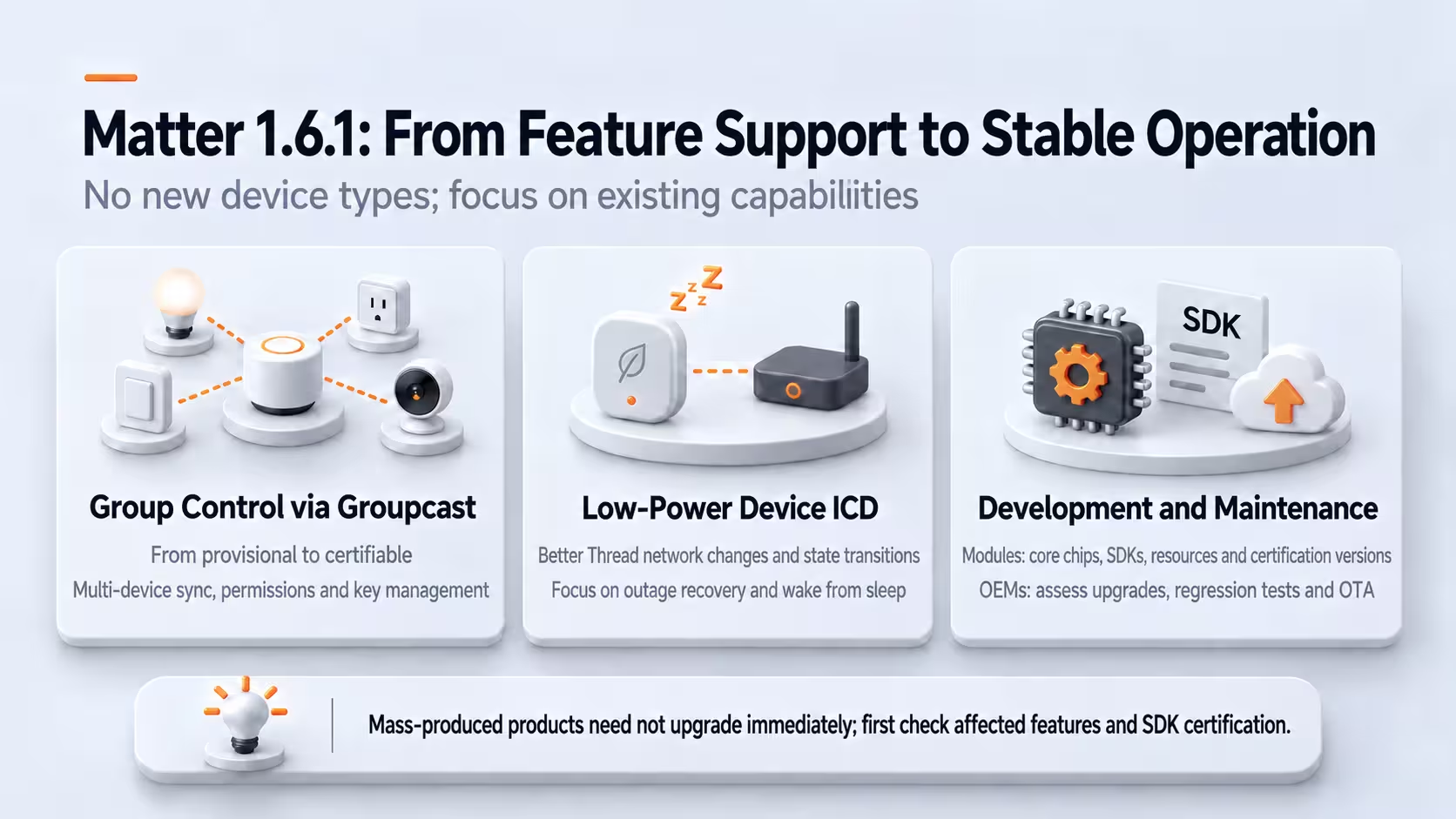
Matter 1.6 introduced capabilities such as NFC-based commissioning and Joint Fabric, while Matter 1.6.1 focuses on improvements to group control, access control, low-power devices, and protocol implementation.
One notable update is Groupcast, an important mechanism for controlling multiple devices as a group. In Matter 1.6, this capability was still marked as Provisional. With Matter 1.6.1, the relevant specification has been finalized and Groupcast is now Certifiable.
Group control is common in smart homes and smart buildings. For example, a single switch may control several living room lights, a hotel management system may turn off all the lights in a guest room, or a building management system may control devices across an entire area.
If the controller sends commands to each device individually, communication traffic increases as more devices are added, and devices may not respond at the same time.
Matter 1.6.1 further refines Groupcast and its integration with access control and group key management, providing a more consistent approach to multi-device control, permissions, and secure communication.
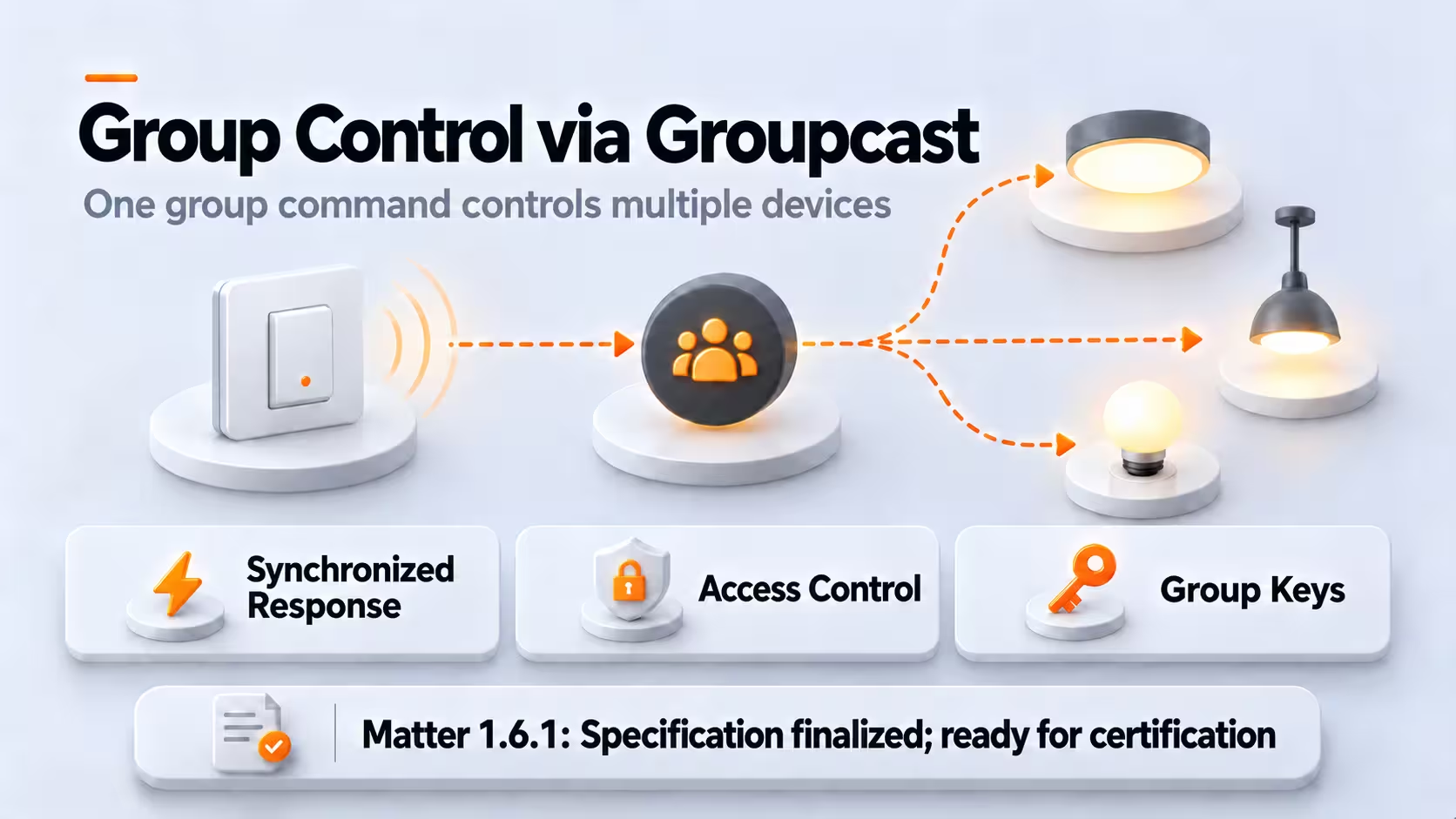
In real-world products, group control involves more than making devices respond together. It also requires proper handling of changes in group membership, access permissions, and key updates.
Module vendors need to verify that their SDKs, secure storage, and device resources meet these requirements. OEMs also need to consider whether group configurations and access permissions can be updated reliably after devices have been deployed.
Beyond multi-device control, Matter 1.6.1 also improves the long-term reliability of low-power devices. One area of focus is Intermittently Connected Devices (ICD), which include certain sensors, smart locks, and other battery-powered devices designed to spend extended periods in sleep mode.
These devices remain asleep most of the time and wake only when communication is required. When networks become temporarily unavailable, devices reconnect, or commissioning states change, they need to handle wake-up and communication states correctly.
Matter 1.6.1 addresses several ICD-related issues involving Thread network state changes, commissioning procedures, and state transitions, helping improve the reliability of low-power devices in complex network environments.
Such problems may not always appear during laboratory testing. A device may complete initial commissioning successfully but later encounter network outages, router restarts, sleep and wake cycles, firmware updates, or configuration changes.
For battery-powered Matter over Thread products in particular, manufacturers should thoroughly test network recovery, extended sleep periods, and reconnection scenarios before mass production, rather than focusing only on initial commissioning.
For module vendors, claiming support for Matter 1.6.1 should mean more than adding a version number to a product specification.
Actual product delivery requires clear information about the chip platform, SDK version, device types, supported clusters, real-time operating system, and certification test version.
Vendors should specify which device types have been validated, which features are supported, which capabilities are ready for certification, and which SDK and chip platform combinations have been tested.
For scenarios involving group control, low-power devices, and multiple administrators, vendors also need to verify that Flash, RAM, secure storage, and key management capabilities meet the relevant requirements.
OEMs should consider the same information when selecting modules to avoid discovering incomplete features, insufficient chip resources, or SDK incompatibilities during development or certification.
For products already developed or being manufactured with Matter 1.6, there is no need to upgrade immediately simply because Matter 1.6.1 has been released.
Manufacturers should first determine whether the update affects existing features, whether the current SDK has been validated, and what additional regression testing or certification work may be required after upgrading.
For devices already shipped, the main considerations are OTA updates, version compatibility, and ongoing maintenance. OEMs need to assess whether an upgrade is necessary and whether existing device configurations, network connections, and user experience can be preserved.
Matter 1.6.1 does not introduce a large number of new features. Instead, it further refines existing capabilities such as Groupcast, ICD, access control, and group key management.
These improvements benefit new product development while also creating opportunities to improve the long-term operation of devices already in production.
For module vendors and OEMs, supporting a particular Matter version is only the starting point. Ensuring that features work reliably in real-world environments, while managing subsequent upgrades and maintenance, remains an ongoing responsibility after product delivery.