Launching a Matter PKI and successfully issuing DACs is only the beginning. OEMs still need to manage ongoing service maintenance, staffing, factory authorizations, audit logs, and incident response. This article examines the long-term costs and responsibilities of operating Matter PKI, including the considerations for in-house and managed solutions.
The Matter PKI is live, DAC issuance is working, and the first factory has successfully completed the production workflow. At this point, the team can finally relax a little. But as products continue to ship, new tasks will come up. Expanding production requires changes to factory authorizations. Staff responsible for certificate issuance may move to other roles and need to hand over their work. When something goes wrong with the system, the production line still needs someone to resolve the issue.
Matter PKI is the Public Key Infrastructure that supports the issuance of Device Attestation Certificates (DACs). Once it goes into operation, ongoing service maintenance, permission management, production support, and security incident response all need someone to take responsibility. Whether an OEM operates its own PKI or uses a service provider, it is worth clarifying who handles these tasks and how much they cost before choosing a solution.
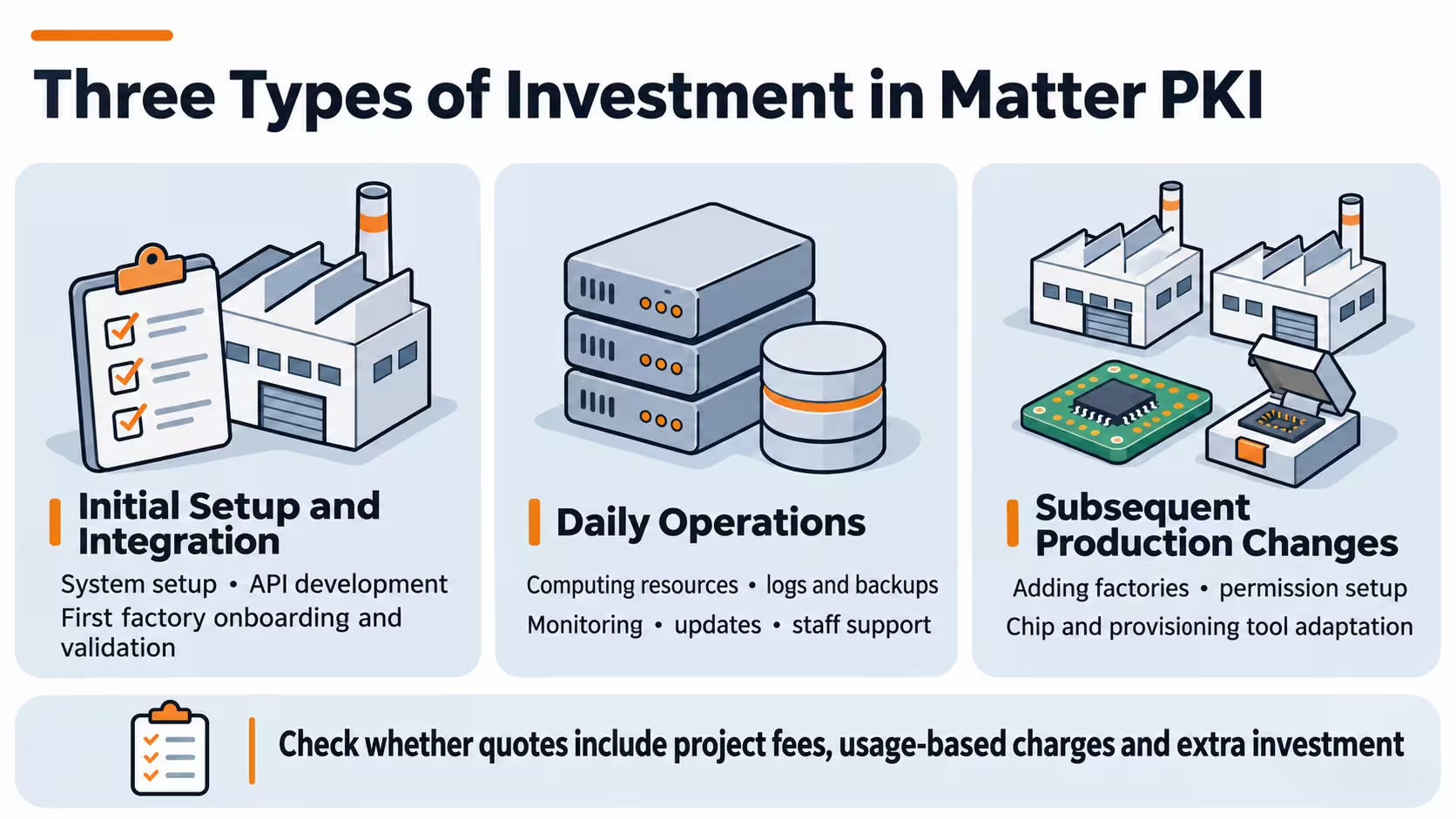
Initial setup costs are usually straightforward to estimate: system deployment, initial configuration, API development, and integration and validation at the first factory. Once the system is running, costs are spread across infrastructure, services, and ongoing staff involvement.
For example, the infrastructure required for certificate issuance, log storage, monitoring, and backups all need maintenance. Software maintained in-house requires updates and validation. When using cloud or managed services, OEMs need to understand the pricing model, service scope, and support conditions. If audits or assessments are required, the company must also arrange the necessary work according to its role and applicable requirements.
Production changes bring additional costs. Adding a factory involves integration, permission configuration, and trial production checks. Changing chips or programming tools may require adapting the device key generation, certificate provisioning, and production result reporting workflows. These tasks are separate from routine PKI maintenance, but they still need to be included in the OEM's manufacturing budget.
When comparing solutions, it helps to divide costs into three categories: initial setup and integration, ongoing operations, and future production changes. Then confirm which items are included in the quoted price, which are billed based on usage, and which require additional staff or services.
Looking only at the initial setup cost or the price per DAC can easily overlook the work the OEM will need to handle later.
Once the costs are clear, the next step is finding people who can take responsibility for the work. Maintaining certificate issuance services, managing keys and permissions, integrating factories, and troubleshooting production issues require different skills and procedures.
The development team may complete the initial API integration, but someone still needs to monitor alerts after launch, approve permission changes, and help factories troubleshoot problems. These responsibilities must be assigned separately.
For companies operating their own Certificate Authority (CA), the CSA PKI Certificate Policy includes requirements for trusted roles, personnel qualifications, training, and separation of duties. In practice, companies need to assign responsibilities according to their roles and assess whether existing staff have the skills and time to manage them continuously.
These arrangements also need to work when personnel change. Who takes over when the person responsible for certificate issuance is on leave? When employees change roles or leave the company, who updates their access permissions and takes over unresolved issues? Operating procedures, contact information, and issue records need to stay current so that critical processes do not depend on a single person.
Managed services also require clear coordination between the OEM and service provider. Does the provider handle production line integration? Will it support factories when programming errors occur? Who is responsible for onboarding new factories?
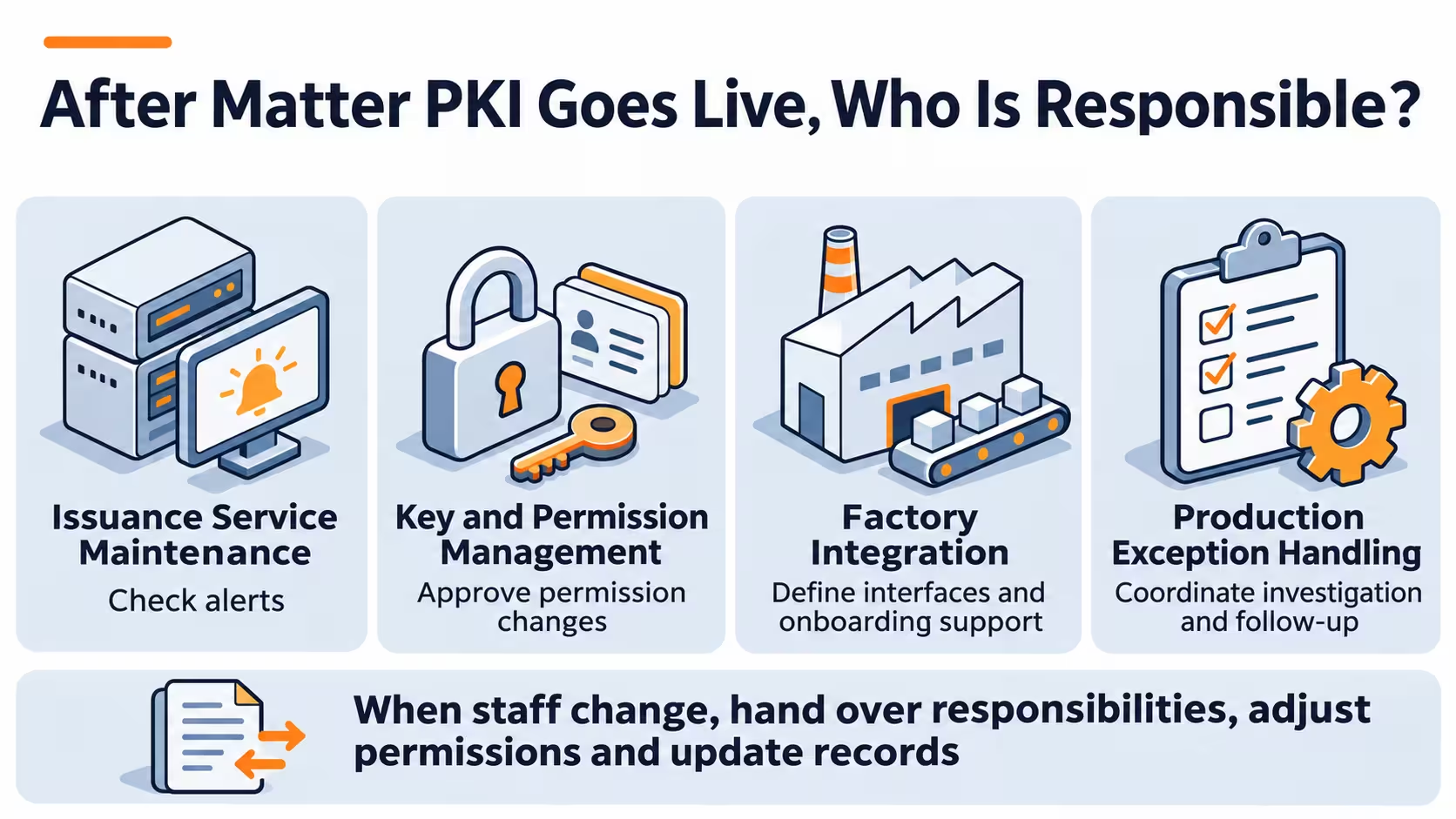
These responsibilities should be clearly defined in the service agreement. The OEM also needs designated contacts to coordinate production schedules, authorization approvals, and issue resolution.
Successfully issuing a DAC only confirms that a particular issuance request was completed. Other controls are needed to verify whether the request came from an authorized factory, which production task it belonged to, and whether the operation can be traced.
Production environments change constantly. When a new factory is onboarded, the OEM needs to define which products it can request certificates for, how many devices it is authorized to produce, and how long that authorization remains valid. When a partnership ends, unnecessary access credentials and authorizations need to be addressed. Changes in employee roles should also trigger a review of existing permissions.
These controls must be implemented through actual accounts, APIs, and production workflows. If certificate issuance permissions and production authorizations are maintained in separate systems, the OEM needs a way to verify that they remain consistent. Otherwise, one system may continue using outdated settings after changes have been made elsewhere.
Operational records also need regular review. It should be possible to determine who submitted a request, which authorization was used, whether issuance succeeded, and whether the certificate was subsequently written to the intended device.
The CSA PKI Certificate Policy includes requirements for retaining, protecting, and reviewing audit logs. On the production side, issuance results also need to be linked to devices and batches to support routine checks and troubleshooting.
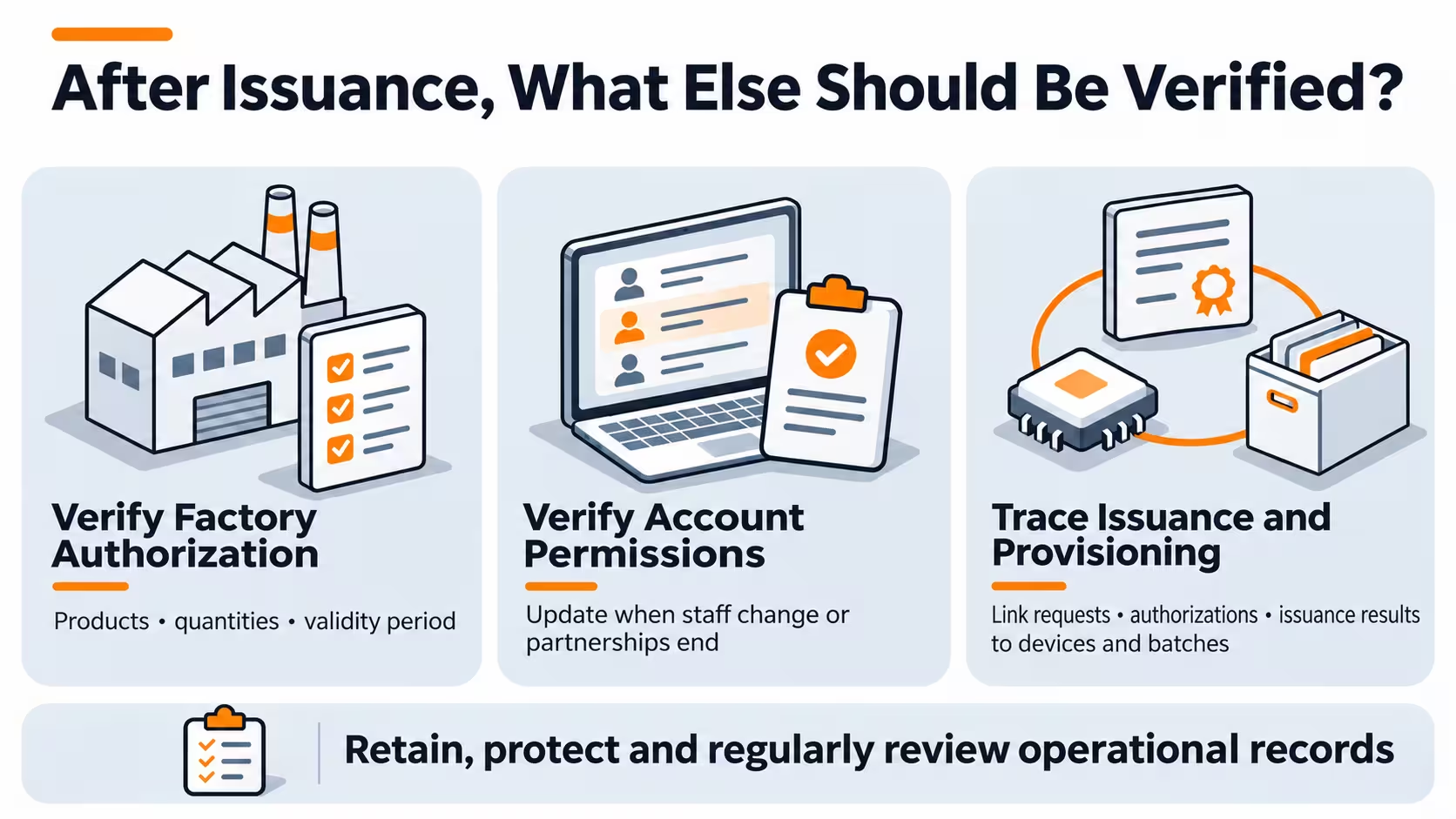
When using cloud or managed services, the OEM should also clarify who approves permissions, who manages production authorizations, who reviews records, and what information the OEM can access. These responsibilities should be documented in the solution.
Whether responsibilities are clearly assigned often becomes apparent when an incident occurs.
Consider an interruption to the certificate issuance service. Who should the factory contact when requests start failing? Is the problem caused by the network, access permissions, or the issuance service itself? Which production batches are affected? Can production continue under a previously validated contingency plan? Operations, certificate service, and factory personnel need to work together to answer these questions.
When restoring the service, the team also needs to check that data and records are complete. Which DACs were issued before the interruption? Which have already been written to devices, and which are still pending? How should unfinished operations be handled after recovery?
There must be reliable records to support these decisions. Backup and recovery procedures should be tested in advance, rather than discovering during an outage that required configurations, permissions, or operating instructions are missing.
A suspected signing key compromise requires a security incident response. The team must assess the possible impact using access records, issuance logs, and other evidence, identify affected certificates and devices, and determine whether issuance should be suspended or whether notification or revocation is necessary. The CSA PKI Certificate Policy includes provisions covering incident handling, key compromise, and business recovery.
In such cases, restoring the service alone is not enough. The team must determine which keys and certificate chains to use afterward, what configurations need to change, and when factories can resume production based on the investigation results. Monitoring, record retention, recovery preparation, and incident response exercises should therefore be part of routine operations.
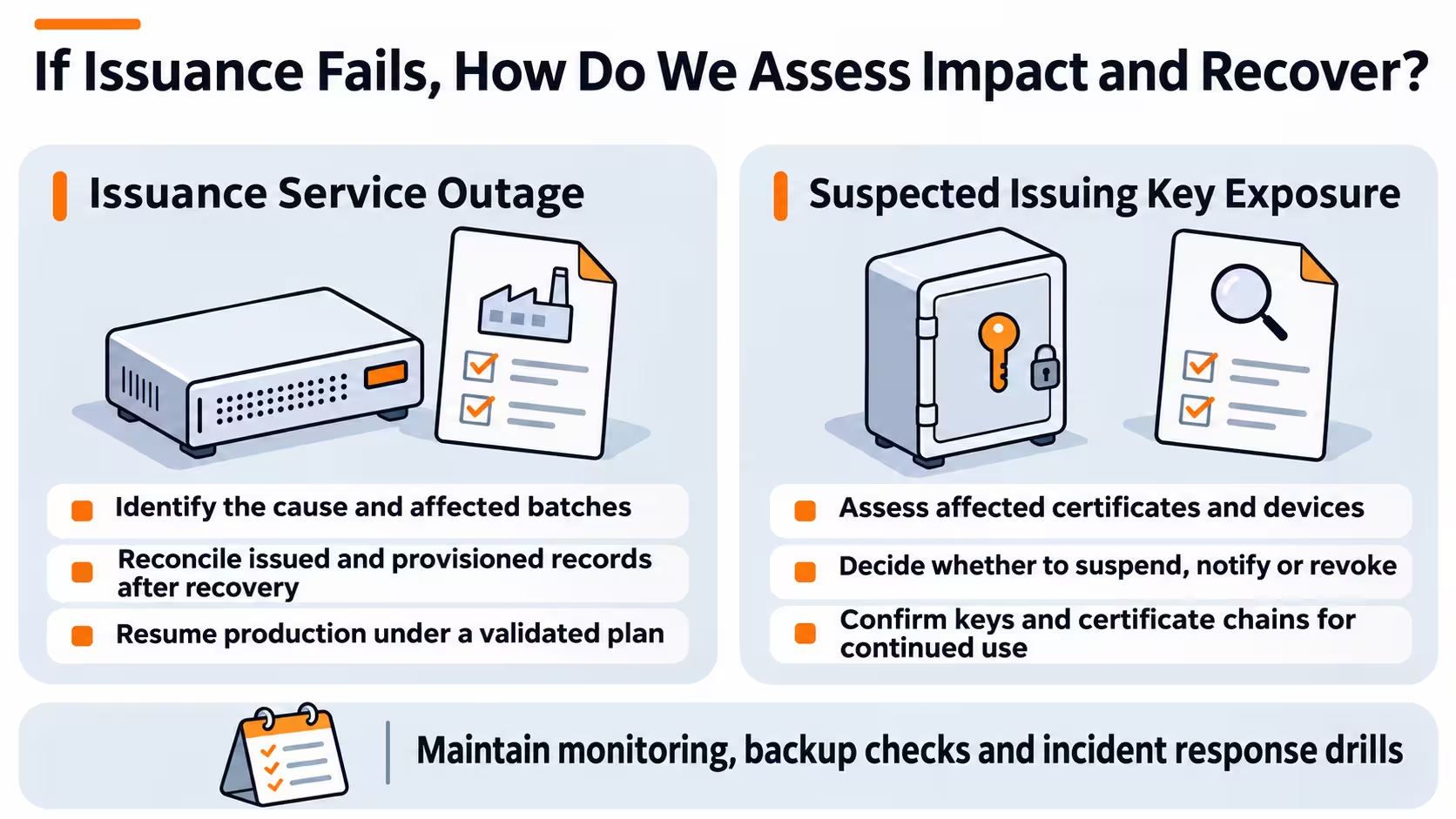
An exercise can check whether alerts reach the responsible people, whether relevant records can be retrieved promptly, whether backup personnel can follow the procedures, and whether factories understand the production arrangements during an incident.
When evaluating a Matter PKI solution, OEMs can start with practical questions: Who handles daily maintenance? Who approves permissions? Who supports factories? Who responds when something goes wrong? The costs and service scope of these responsibilities should then be compared together.
OEMs with established teams can assess which tasks can be handled within their existing operations. Those looking to reduce setup and maintenance work can consider assigning certain responsibilities to a service provider. The important thing is to define ownership for specific tasks so that nothing falls between the certificate issuance service, factory tools, and internal teams.
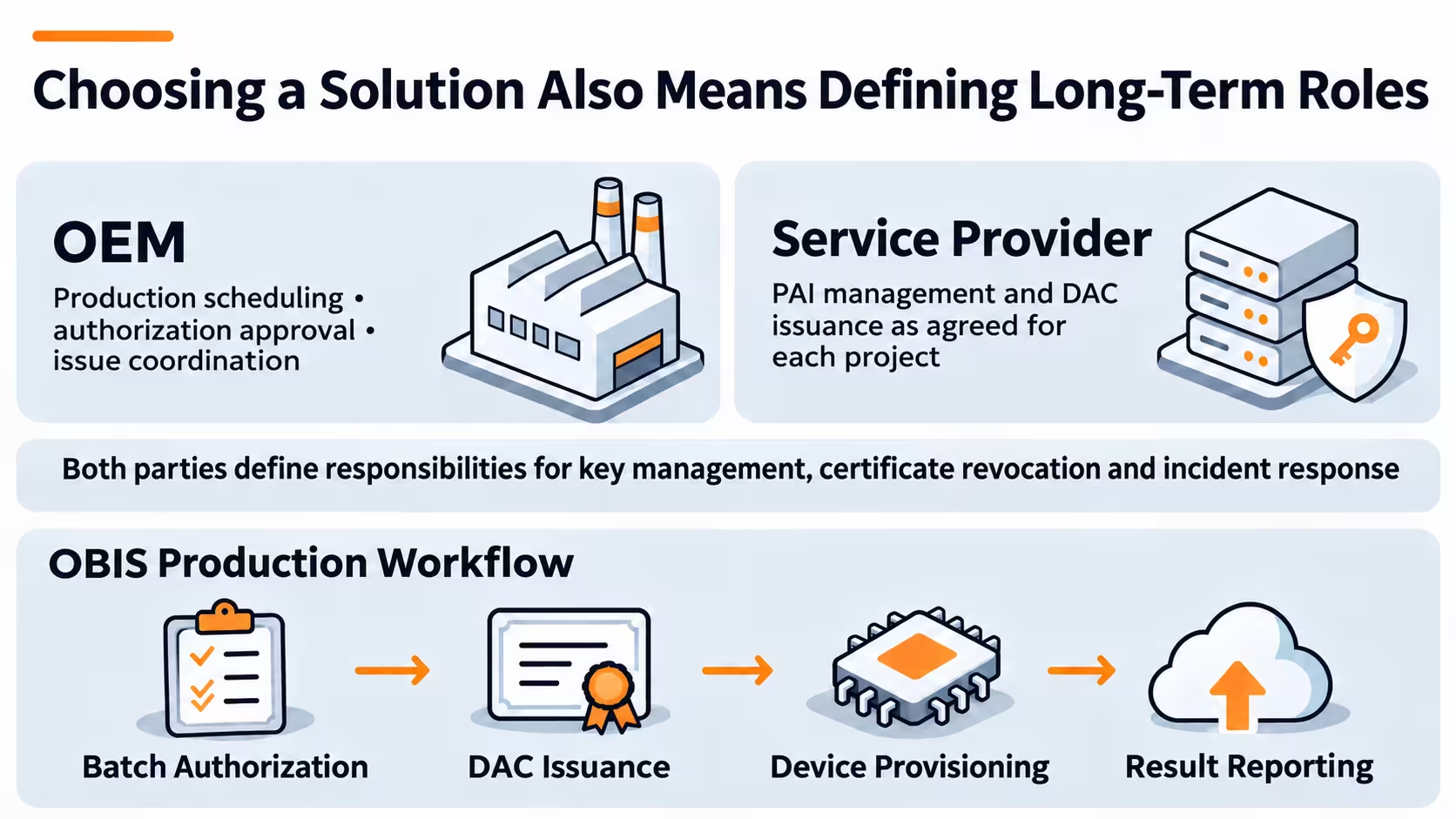
Snowball Technology can provide PAI management, DAC issuance, and related operational services based on an OEM's existing certificate infrastructure and the agreed project scope. OEMs can retain their own PAA or evaluate using Snowball Technology's PAA, with clear responsibilities for key management, certificate revocation, and incident response.
For manufacturing, the OnBoard™ IoT Security (OBIS) platform connects factory batch authorization, DAC issuance, device programming, and production result reporting. OEMs can centrally manage production authorizations across different factories and look up reported issuance and programming records for individual devices. This reduces the need to repeatedly reconcile information between certificate systems, factory tools, and production personnel.
After a Matter PKI goes live, products and factories will continue to change, and the people responsible may change as well. Including these ongoing tasks in budgets, staffing plans, and responsibility assignments helps ensure that certificate issuance continues to support production and that problems can be traced to the right people and records.